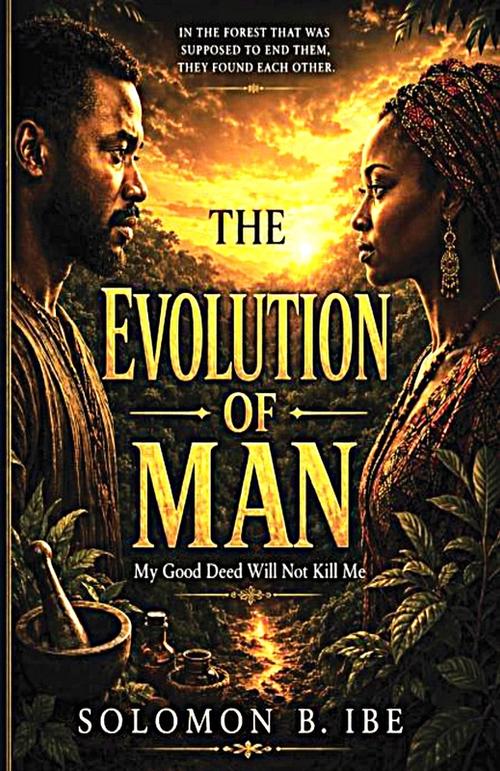
FictionTHE EVOLUTION OF MAN
My Good Deed Will Not Kill Me
$25.00 $4.99
In the heart of a southeastern Nigerian forest, two broken souls find each other.
Chinaka walked into the trees to die, abandoned by his wife, mocked by his village, crushed by poverty and shame. Ogomuegbulam was bound and left for dead by the community that once called her family, condemned for the crime of childlessness.
Instead of death, the forest gave them something neither expected: healing, purpose, and the radical possibility of becoming new.
Together, they learn the ancient secrets of the trees, build a place of refuge for the suffering, and discover that some good deeds refuse to be buried. As their past returns to demand reckoning, Chinaka and Ogomuegbulam must decide whether the love and knowledge they’ve found are strong enough to face the world that tried to destroy them.
The Evolution of Man is a powerful story of redemption, traditional wisdom, and the quiet triumph of the human spirit. In the forest that was supposed to end them, they learned how to live and how to heal.
Description
In the ancient forests of southeastern Nigeria, two discarded souls discover that survival is only the beginning.
Chinaka enters the forest carrying nothing but the weight of a broken life, a wife and children who left him, a village that mocked his poverty, and a despair so complete he intends never to leave. Ogomuegbulam is bound at the wrists and abandoned to die by the very community that once called her family, condemned for the unforgivable crime of childlessness.
Instead of death, the forest offers them something neither expected: healing, knowledge, and the quiet, radical possibility of becoming new.
As Chinaka learns the secret medicines hidden in the trees and begins to heal those who find their way to his shelter, Ogomuegbulam becomes his partner in both work and survival. Together, two broken things slowly learn to mend not just their wounds, but each other.
When the past returns the village that failed them, the accusations that nearly killed them, and the family Chinaka thought he had lost forever, they must decide whether the life they have built in the forest is strong enough to face the world outside.
The Evolution of Man: My Good Deed Will Not Kill Me is a powerful, deeply moving story of redemption, traditional African wisdom, forgiveness, and the extraordinary resilience of the human spirit. It asks what remains when everything is taken and proves that even in the darkest places, goodness can take root and flourish.
A testament to the healing power of nature, community, and quiet love, this novel reminds us that the forest does not waste anything it receives.
Sample Chapter
Chapter Four
Two Broken Things: Learning to Mend
She did not finish the story that first night. She got as far as Tobenna's wife, as far as the first whisper of witchcraft, and then her voice stopped working. It was not grief. Her body had come close to dying and had nothing spare for talking.
Chinaka did not press her. He banked the fire, lifted the fomentation to see how the rope wounds on her wrists were drawing, and told her to sleep. She slept, no argument at all, which was what worried him.
He sat up a while after her breathing went deep and heavy. An owl east of the camp. Something large shifting through undergrowth, keeping a polite distance. The stream going on underneath all of it, the way it had gone on every night since he came.
He kept turning over what she had said. A woman who does not give her husband children is already halfway to being accused of something. He had been hearing that sentence, or versions of it, since he was a boy. In Udelu, men said such things the way they said the rains were late. Nobody argued with the rains. He had never had to sit across a fire from what the saying produced.
Asleep, her face let go of some of its guarding. He noticed his own jaw was tight. He was angry, and not on his own behalf; he had burned through that supply months ago. Anger for someone else turned out to be easier to hold. It was also the first thing he had felt clearly since he walked into the forest.
By the fifth day, she was better. Not well. She would not be well for weeks. But she could sit up without his arm behind her, finished the broth of boiled roots and river herbs without being coaxed, and turned her head to follow birds through the canopy, which he took as the better of the two signs.
That afternoon she watched him work. He had been out on the herb trail since morning and come back with an armful of leaves, two roots, and a strip of bark he had been testing on wounds. It seemed to pull infection out. He was not certain yet. He set everything on the flat stone near the fire and began sorting.
"Where did you learn this?" she asked.
"Here." He did not look up.
"In this forest?"
"Yes."
She watched his hands instead of his face. Careful hands, not delicate but exact, belonging to someone who had trained himself to notice things.
"How long have you been here?"
He had to think about it. Time in the forest did not measure the same as time in a village. "Close to twelve months. Perhaps more."
"Alone?"
"Yes."
She let the pause sit. She had learned, the hard way, that a question can be a weapon. "What brought you here?"
He finished stripping the bark, set it aside, picked up a root. "I came here to die."
She did not gasp. No hand to the mouth, none of the small noises people make to fill a hole like that. She looked at him.
"But you did not."
"No."
"Why?"
He looked up. "I am still trying to understand that."
She nodded, as though that were answer enough, and turned back to the birds.