
Before I ever understood the meaning of philosophy, psychology, or even education itself, I had already encountered all three through storytelling.
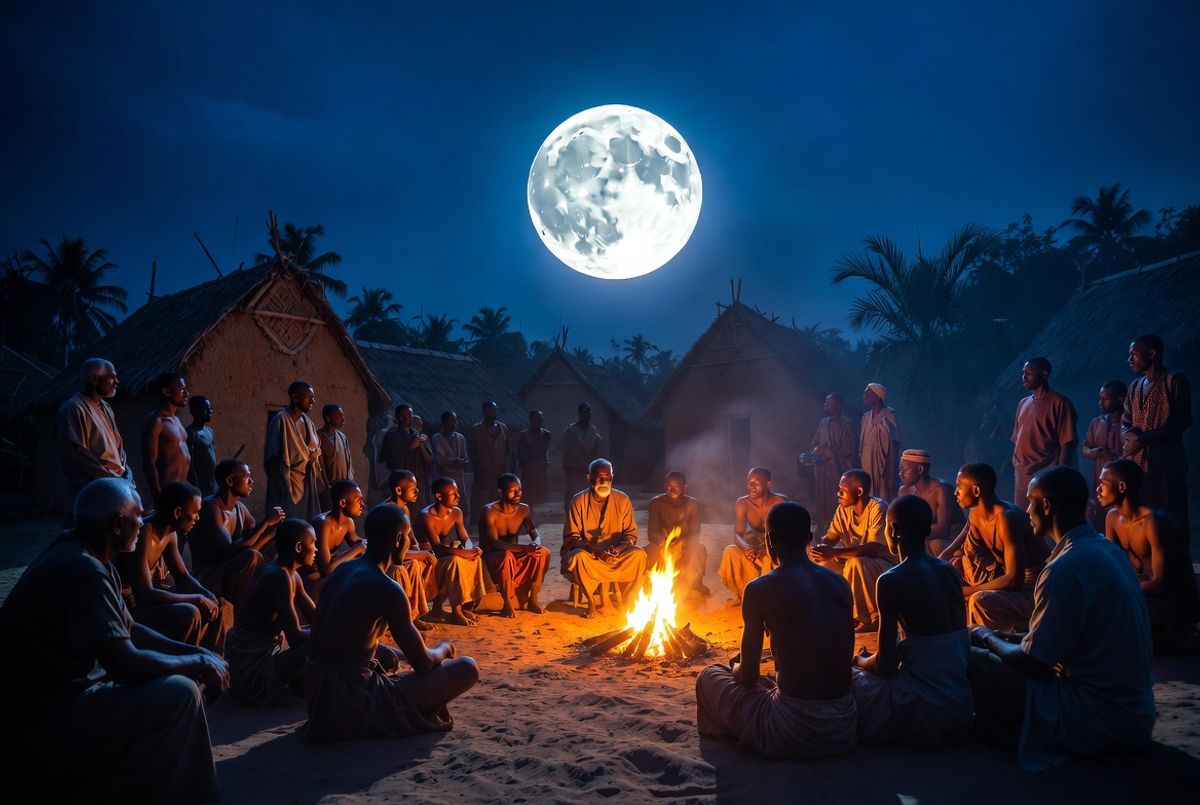
In every Igbo village, beneath the soft silver light of the moon, the village square served as our first library, our first classroom, and our first university. Long before printed books, formal schools, and digital screens, knowledge traveled through the human voice. Around glowing fires, with crickets singing in the background and children leaning against their mothers, stories were shared not merely to entertain, but to preserve memory, transmit wisdom, and shape the moral imagination of an entire people.
This is one of the greatest truths of Igbo civilization: we understood that human beings do not live by facts alone. We live by stories.
More Than Entertainment
To describe traditional Igbo storytelling as entertainment is to misunderstand its purpose entirely.
Stories were our philosophy lessons. They were our ethical debates. They were our historical archives and our spiritual education. When an elder began with words such as, "In the days when the earth and sky were still friends...", everyone understood that something sacred was about to occur.
The storyteller was not simply recounting events. He was opening a bridge between worlds, between the living and the ancestors, between the past and the present, between the individual and the community.
In those moments, we were not merely listening.
We were remembering who we were.
The Sacred Responsibility of the Onye Akụkọ
In traditional Igbo society, the Onye Akụkọ, the storyteller, carried enormous responsibility. They were historians, philosophers, teachers, and guardians of collective memory.
Their stories were never empty. Every tale contained a lesson hidden beneath humor, tragedy, conflict, or triumph. Through the cleverness of Mbe the tortoise, we learned about wisdom and deception. Through the suffering of the orphan, we learned resilience and compassion. Through the downfall of arrogant men, we learned humility.
Our ancestors understood something modern society often forgets: people rarely change because of arguments. They change because of stories.
This is why proverbs occupied such an important place in Igbo culture. As Chinua Achebe famously wrote, proverbs are "the palm oil with which words are eaten." Without them, language loses its depth. Wisdom becomes information instead of understanding.
Stories Build Reality
As I have grown older and reflected more deeply on culture, belief, and identity, I have come to a conviction that shapes much of my own writing:
Stories do not simply describe reality. They create it.
The stories a society tells determine what it values, what it fears, what it remembers, and ultimately what it becomes. Every story carries an invisible architecture that shapes the minds of those who inherit it.
Perhaps this is why societies fight so fiercely over narratives. To control the story is often to control the imagination of a people.
A community disconnected from its stories is like a person who has lost their chi: alive but untethered; moving, but directionless.
Through storytelling, we recover our memory. Through memory, we recover ourselves.
Carrying the Village Square Into the Future
Today, many of us write, publish, and communicate through technologies our ancestors could never have imagined. The moonlit village square has become websites, digital books, podcasts, and social media platforms.
Yet the fundamental question remains the same: How do we preserve the soul of our stories while adapting to a changing world?
I do not believe the answer lies in abandoning our traditions or merely imitating foreign forms. Rather, it lies in carrying forward the essence of what made our storytelling traditions powerful in the first place: honesty, wisdom, communal memory, spiritual depth, and moral courage.
The medium may change. The firelight may become a computer screen. But the responsibility remains. We must continue to tell stories that remind us that onye kwe, chi ya ekwe when a person perseveres, their spirit joins them in that perseverance. We must tell stories that preserve our humanity, challenge our assumptions, confront our failures, and sustain hope.
Because as long as we continue to tell our stories with truth and courage, the village square never truly disappears. It simply finds a new place to gather.